My take on Facer and Sandford's projections of the future
Facer and Sandford offer three future scenarios. As cold and somber as it sounds, 'World 1: Trust Yourself' appears the most viable scenario to me. For the past few weeks, I have been reading heavily about the current debate over 'what qualifies as news' for my final project for the Master's program at Teachers College, Columbia University. One of the questions that are commonly discussed in research articles is 'fake news' and 'in-group & out-group scenarios.'
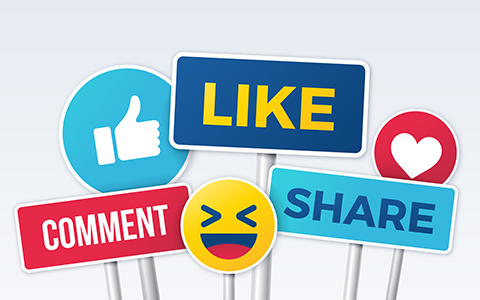 |
| Various user engagement features offered by social media |
Social media offers various features, such as share, like, and comment, that allow users to actively participate in news creation and production. While the new platform has made information accessible, we are now facing some unforeseen consequences, such as fake news and in-group & out-group problems. Because anyone can share news content online without going through the heavy fact-checking process that defines traditional journalism, the web is inundated with unreliable and misleading content. Also, the majority of content on social media is shared by friends or family. Despite the popular claim that the online world can open people up to new knowledge and ideas, such shared contents might end up pigeonholing one's digital experience (and even political views), hence aggravating the social division in our real world.
These risks remind users to become more aware of what they are seeing and sharing online; to not just mindlessly intake all the content available in the web, but rather become more conscious about what is 'right' and 'wrong,' who shared the content, and why this content showed up on their news feed. In order to become the 'independent consumer' of social media, everyone is asked to make 'informed choice,' as what Facer and Sandford describe in their first scenario.
One potential scenario that has not been discussed in the article is that social inequality might increase. For each person to become the wise consumer of online content, he/she should be tech-savvy. He/she should also have reached a certain cognition level to make decisions about the quality of news. Because these abilities usually come with a certain degree of education, it can be projected that for people with higher education will become more successful consumers of online content than those without. Based on this scenario, the social segregation in our current world can also be replicated in the virtual space.
 |
| Fact vs. Fake News |
Another potential scenario is the renaissance of traditional media. Because people become so tired of reading less credible content online, they might turn back to old media, such as newspapers, TV and radio news, whose publishing right is strictly restricted to journalists. Especially after the last election in the U.S., people have become aware that they should no longer fully trust what they see online. For instance, when I talked to a lady at a cafe for my news research project for Dr. Chang (a separate project from the ICT course), she openly said she does not read news from Twitter or Facebook. She said she would rather spend that time reading verified news from The New York Times. As such, while people say traditional media is dying, the risks with social media might rekindle the popularity of old media instead.

References:
Facer, K., & Sandford, R. (2010). The next 25 years?: Future scenarios and future directions for
education and technology. Journal of Computer Assisted Learning, 26, 74–93.

Comments
Post a Comment